Monday, August 29, 2016

Feedback Signals: To use or not to use?

Feedback Signals
Feedback signals and hand signals are non-verbal signals used to help run group management.  It was originally introduced in Kagan's cooperative structures to check for comprehension.  It helps facilitators and in our case, the teacher, to see emerging results and immediate feedback.  Some teachers told me isn't that against the idea of cultivating the communicative skills. The TL is used when teachers have given a task and wants to know whether all students understand the task- immediate feedback from all. Or after explaining a concept, the teacher may use TL. TL gives a voice to each child, especially those who might be too shy. Every time a teacher asks whether students understand, there will be a few who might be too afraid to say anything.When all students are required to use the TL, everyone has a chance for their learning to be more effective.  No where should it be used to replace communicative activities.


For a class with only two students, I guess you might not need quiet signal or TL but in my observations in the classroom, students enjoy using it.


THE QUIET SIGNAL


Image result for kagan's feedback signals


According to Kagan's research, we lose 18 days requesting our students to keep quiet.  I sometimes see teachers stuggling, shouting "Listen, listen, listen!"  The goal should be to obtain silence and attention within 5 seconds.  Hence, the need for the quiet signal.  It is not about not giving the chance for students to speak.  There is a time for everything in a classroom.  If teachers cannot command the attention of the students when they are in groups, it would be tiring for the teacher to explain to every group. Some teachers use a chant to gain attention, some use "High Five" or 'Give me five".

😁

Friday, June 17, 2016

Transforming the Classroom, School by School


Sharing some ideas from my visits to schools everyday.  These pictures are taken at SK KUALA SLIM, Slim River.  They have just got started in transforming the classrooms.


As you can see, the tables have been arranged in fours and are slanted so that students can also see the whiteboard clearly.


These are reward stars for the students.  Each student has a container to house the stars that he has earned.


                Teacher has added a parking lot for all subjects.


                     Traffic lights are ready to roll.


                             Reward charts and birthdays are shown on the board.


Calendars


I love this chart to show those who are present and absent.


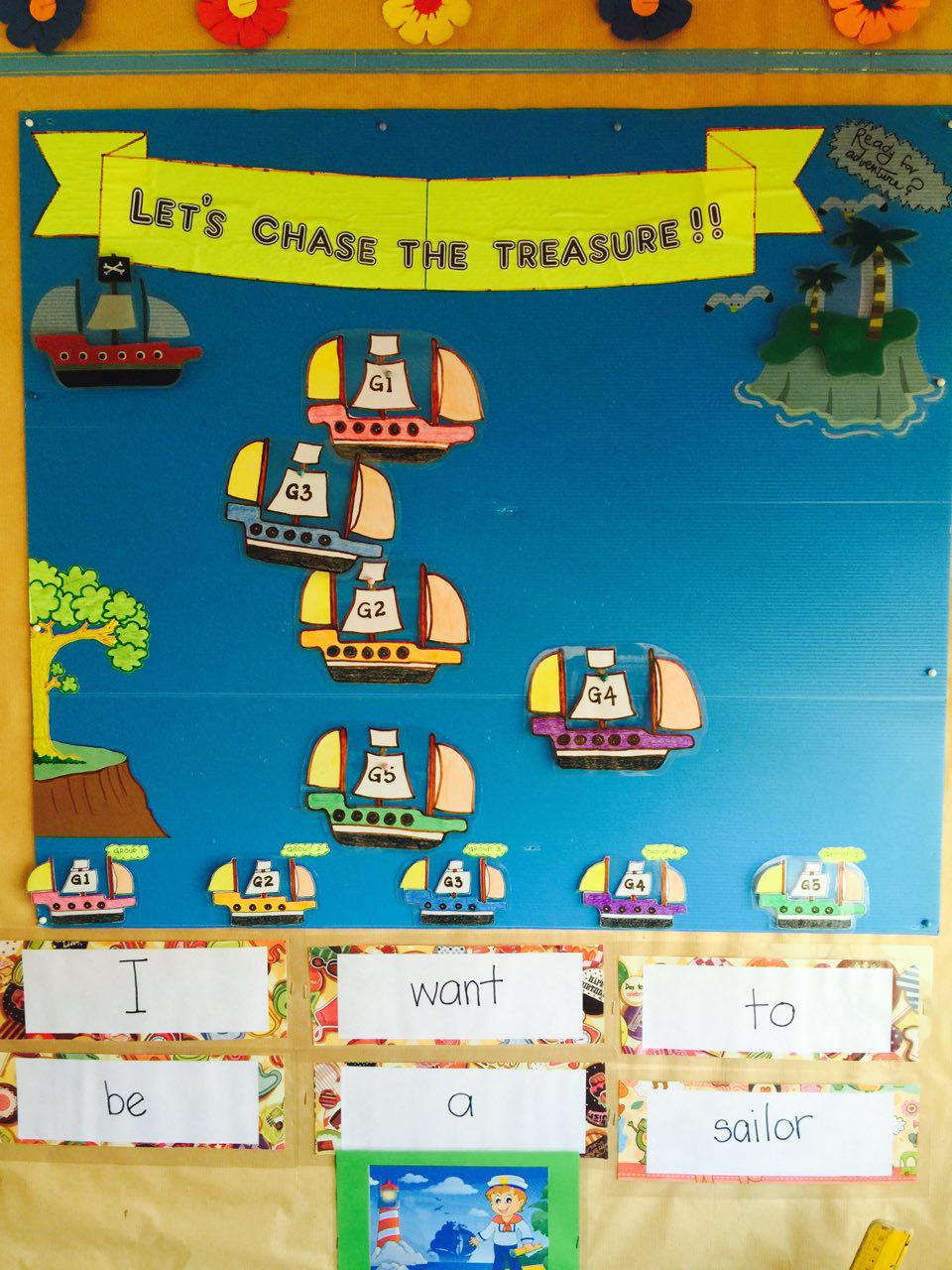
This is a reward chart, using the ships to chart their progress.


The role tags for group work are done.

Friday, May 20, 2016

Tips for Organising Group Work

There are a few things to remember when you are implementing group work.  Many teachers ask students to work in groups to complete an activity but often, collaboration is not seen.  How do we ensure that group work is implemented correctly?


1   Determine the learning objective that you want students to achieve.  Ensure that the group activity you are organising plays a role towards the learning objective and not just a mere activity.

2  Share the purpose of the activity and model the target language or product if the class is weaker.
This means telling the students exactly what they have to do or showing what their final product might be like, allowing some room for creativity.  Use the quiet signal to get the attention of the students before giving instructions.  After the instructions, ask for feedback through the traffic lights.

3  Determine a time limit for each activity to provide some competition and suspense.  Stop the activity by using the quiet signal.  You can provide more time if you want at the end of the time limit.  Often, I see teachers allowing too much time for one activity and students become bored and start their own mini party.

4  While students are doing their work, monitor each group by moving around.  Do not start to interfere the minute you sense something is wrong.  Prompt the group to solve the problem.  Ask Three Before Me would be a good principle for students.


5  After the group activity has been completed, it is important to decide on how you want the reporting to be done.  The usual senario is the teacher asks each group to come up to present their work.  After the second or third group, the whole class will lose interest as they feel that they are going through the motion.  I would recommend doing a carousel feedback or gallery walk.  Groups put up their work then  circulate around the room and read each other’s answers, They can add their own comments in response. I would normally move around with my post-it notes and give comments.


6  Give a closure by summarizing the main points that have been presented.  You can also ask students to do a reflection of their work and what they have learnt for the day.

7  Always reflect on the group activity afterward.  Reflect on what worked and what could be improved.  


PROBLEMS
1  Students have nothing to say in a listening and speaking activity
    Provide more help in the target language.  Students who are weak might be unable to
    produce anything.  Give more notes or help with pictures.

2   Students are unhappy with their group members.
     Spend some time doing team-building activities and ice-breakers before introducing serious
     work.


Sunday, April 24, 2016

TALKING CHIP AND SPIN IT

I want to share two cooperative learning structures that would surely encourage some communication.

TALKING CHIP

Materials:
Talking chips
Mat


How do I start?
 Each student receives one or two “talking chip.” The chips can be any kind of game token, or a coin.  As shown above, I recommended these little smiley magnets from Mr DIY or any departmental store.   In order to speak, a student must place his or her chip in the center of the talking mat.  The teacher must model the language structure expected.  For example, in the first picture, the teacher wanted the students to talk about a character in the short story.  The rest of the students must listen quietly till the student finishes.  Another student places his chip on any of the picture or phrases and start speaking.  Everyone takes turn till all the chips are on the table.

Talking Chips ensures that everyone participates or contributes to the discussion.  It is especially useful for shy students, low achievers, and less-fluent students.  However, teachers must provide lots of help with pictures and helpful words for the weaker students.  Do not give up if students are initially shy or did not participate.  Keep experimenting.  I love using game boards for this talking chip activity.


Another game that is easily done is Spin and Talk.  It has been called many names depending on the purpose of the game.  This spinner can easily be done on MSWord, inserta a circle and divide the circle into sections.  All you need is a pencil and a paper clip.  Students take turns spinning the paper clip around the pencil and speak on the topic that the paper clip lands.


You can find the teambuilding spinner here:   http://www.lauracandler.com/strategies/CL/teambuildspin.pdf


These two structures are great as starters or plenary.  You could start off a lesson on hobbies by asking students to do a talking chip activity with a mat that is filled with pictures of hobbies.
You could also end the lesson by asking students to summarize what they have learnt by spinning and talking about it.

Tuesday, April 19, 2016

Quiz Quiz Trade

In a normal classroom, a teacher asks a question, a few students might mumble an answer if you are lucky, and the teacher calls up a student to answer.  How do you get 50% of the classroom to answer at any one time?  You can do this through Quiz Quiz Trade, another of my favourite Kagan structures.


How do I organise it?

Step I:
Give students each a question with an answer or a certain point that you want them to engage in.
For example:  Topic:  Opposites 
I would give students a card each.  Each card would be printed with a word and the student has to say the opposite of the word.

Step 2:
Students hand up to pair with another student.  They ask each other the question on their card.  If the answer is correct, they exchange their cards. They put up their hands to find a new partner. If the answer is wrong, the partner will coach till he gets it right.quiz each other and if they can answer the question, they exchange their cards.

Step 3:
Students keep moving and finding new partners till the teacher stops the activity.  Students come back to their original group to share the new points that they have learnt.


Cards can be prepared with math problems, spelling words, vocabulary words and factual points or anything else you can think of.  The possibilities are ENDLESS!
You can use this structure as a starter activity to generate ideas in a weak class.

Monday, April 18, 2016

TWO STAY TWO STRAY


Two stay two stray is another good cooperative learning structure.  It creates an opportunity for students to present their ideas to another group or to explain a certain concept to another group.  Students could work in pairs or the teacher could adapt and make it, two stay, one stray.  It usually follows a brainstorming session or a response to a situation or problem.
For weaker students, the teacher could provide the structure or even model one 'straying'.

'Good morning, my group would like to present on ways to save the environment.  Firstly, we should......Then, we must ...............   Thank you.'

The aim of this activity is to create opportunities to talk about a subject, to teach a certain concept to someone else, to present an opinion or to solve a problem.  This also increases the speaking confidence of the students.  As this activity takes place simultaneously, maximum participation is ensured.


Sunday, April 17, 2016

GALLERY WALK


The gallery walk is one of the most popular communicative activities among the teachers.  I love it because it offers the students a chance to present simultaneously and students get a chance to respond in small groups.

What is Gallery Walk? It actively involves students in synthesizing important concepts, in consensus building, in writing, and in public speaking.  Groups rotate around the classroom, listening to presentations, reflecting and responding.  

Why use Gallery Walk?  It promotes higher order thinking, oral/written presentation skills, and team building.  It is flexible and has many benefits.  It encourages students to speak and write the language rather than just listening to the teacher or one speaker at a time.  It also invoves cognitive skills involving analysis, evaluation, and synthesis, Gallery Walk has the additional advantage of promoting cooperation, listening skills, and team building.

How to use Gallery Walk? –
This is one way to use Gallery Walk.  Teacher asks each team to stand beside their station or poster sheet.  When the teacher gives a signal, each team moves to the next group except the presenter.   After three to five minutes at a chart or "station" the team rotates to the next group. Those who are listening would be given post-it-notes to write their comments or to do a 'two medals one wish' - what two things are good, and one thing that could be improved.


Another way to use Gallery Walk is where teacher sets up each station with a particular question.  Team rotates from station to station to answer the questions.


I love this activity because it involves maximum participation and students are actively engaged.